
 Get started
The EU ban on vague green claims: what your online store can still say
Since 27 September 2026, vague claims such as “eco-friendly” or “climate neutral” are treated as misleading across the EU unless you can prove them. Here’s what changed, where such claims hide in a Shopify store and how to rewrite them.
On 27 September 2026 the EU’s rules on green claims got much stricter. Directive (EU) 2024/825, known as the directive on empowering consumers for the green transition, added environmental claims to the EU’s list of commercial practices that are always unfair. Always means no case-by-case test: if a claim is on the list, it’s banned.
It covers everything you say to consumers: product pages, titles, badges, banners, ads, emails and packaging. And it doesn’t matter how big your store is.
What is banned now
- Generic environmental claims without proof. Words such as “eco-friendly”, “green”, “sustainable” or “nature positive” are banned unless you can show recognised excellent environmental performance, for example the EU Ecolabel, or you explain the claim specifically right next to it.
- Home-made sustainability labels. A label or badge has to come from a certification scheme or a public authority. A leaf icon with “Eco choice” that you designed yourself is not allowed.
- Claiming for the whole what is true for a part. Calling a product “recycled” because only its packaging is, for example.
- “Climate neutral” through offsetting. Saying a product has a neutral, reduced or positive climate impact because you bought carbon credits is banned.
- Presenting the law as a special feature. Advertising something every product must have anyway, such as the absence of a substance that is already banned.
The same directive also bans misleading durability and repairability claims, and it sets conditions for future promises such as “net zero by 2030”: they need a public, detailed plan with measurable targets and regular independent checks.
What you can still say
The directive doesn’t ban talking about the environment. It bans saying it vaguely. A specific, checkable fact is fine:
- “Packaging made from 100% recycled cardboard” instead of “eco packaging”.
- “98% of ingredients are of plant origin” instead of “natural formula”.
- “Plastic-free packaging: cardboard box and paper tape” instead of “planet friendly”.
- A label from a real certification scheme, such as the EU Ecolabel, if your product has it.
Keep the evidence for every claim, such as supplier certificates, material specifications or test results, so you can show it if a customer or the authority asks.
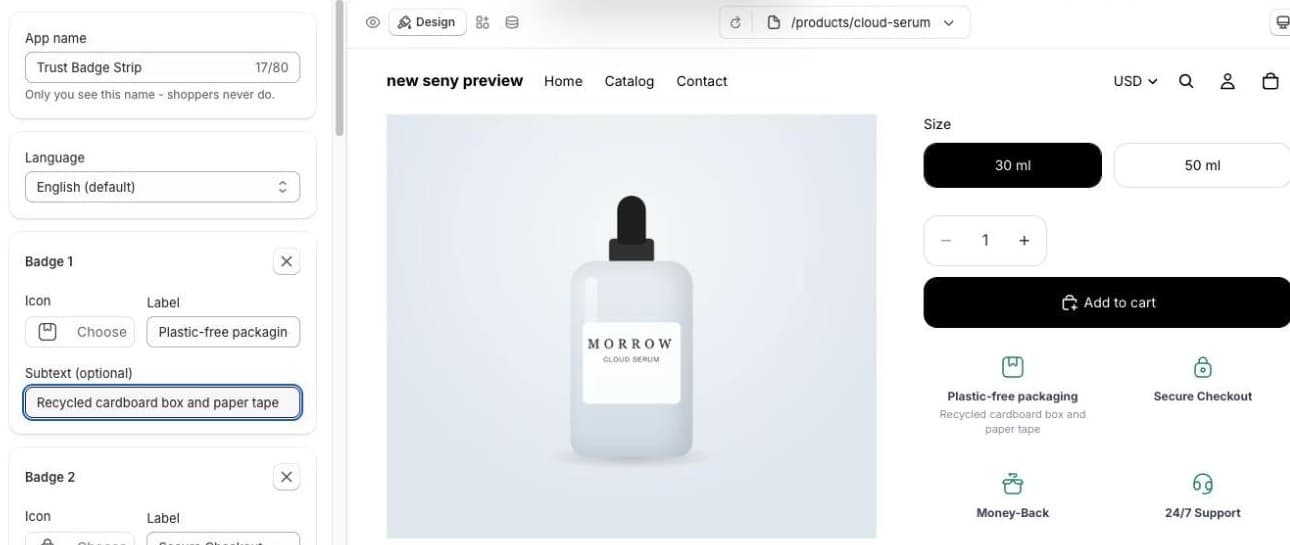
Where green claims hide in a Shopify store
- Product titles and descriptions, including old products you no longer look at.
- Tags, filters and collections, such as an “Eco” filter or a “Sustainable collection”.
- Badges, labels and icons, including leaves, globes and recycling symbols. Design can mislead too: green colours and leaf icons can suggest an eco claim without a single word.
- Theme text: the announcement bar, banners, footer and “About us” page.
- SEO titles, meta descriptions and image alt text, which show up in Google.
- Emails, ads and product feeds, such as Google Shopping and Meta catalogues.
- Translations. A claim in Lithuanian, German or Latvian is still a claim.
Check your store, step by step
- Export your products. In Products, click Export and download the CSV. Search the title, description (Body HTML), tags and SEO columns for words such as eco, green, sustainable, natural, climate, carbon, planet and their translations.
- Go through the rest of the store. Collection names and descriptions, menus under Content → Menus, pages, blog posts and the theme’s own text under Online Store → Themes → Customize.
- Check app widgets. Trust badges, product labels and announcement bars often hold the shortest, vaguest claims.
- Decide claim by claim: keep it (certified and provable), make it specific, or remove it.
- Save the evidence for every claim you keep.
- Update ads and feeds last, so they match the store.
Example: how Lithuania applies it
In Lithuania the stricter rules apply from 27 September 2026 and are supervised by the State Consumer Rights Protection Authority (VVTAT). According to Regionų žinios, general words such as “eko”, “tvarus” and “draugiškas aplinkai” count as misleading unless backed by recognised certificates or clear, verifiable facts. Complaints can come from consumers and from competitors, fines depend on the company’s turnover, and there is no transition period for packaging already on the market.
Common mistakes
- Only fixing the product page. The same claim often sits in tags, alt text, ads and emails.
- Keeping a self-made eco badge. Without a certification scheme behind it, the badge itself is the problem.
- Swapping one vague word for another. “Conscious” or “clean” is just as vague as “eco”.
- Forgetting translations. Check every language your store sells in.
- No evidence on file. A claim you can’t prove when asked is a claim you shouldn’t make.